

Error correction built around native connectivity
Quantum error correction is central to practical fault-tolerant quantum computing. Today’s superconducting hardware is constrained by the physical layout of on-chip couplers and commonly supports only nearest-neighbor connectivity on square grids. Surface codes fit this hardware but have low encoding rates and high physical-qubit overhead. Quantum low-density parity-check codes offer higher rates but often require long-range interactions that are difficult to implement at scale.
To address this tradeoff, Traverse Quantum, Tsinghua University, and Zhongguancun Laboratory developed the Bunny family of quantum error-correcting codes. The approach builds on the experimentally demonstrated AshN scheme and on the ability of superconducting hardware to implement flexible two-qubit gates, designing an efficient correction solution around the hardware’s native connectivity topology.
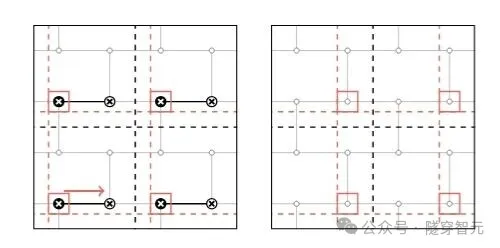
Encoding rate, correction performance, and hardware fit
Bunny codes use the AshN gate scheme’s ability to implement both CNOT and CXSWAP two-qubit gates, enabling flexible routing without additional qubit overhead. Nonadjacent qubits can exchange information efficiently, reducing dependence on long-range couplers and complex hardware structures. The family includes established constructions such as extended bicycle and directional codes as well as new configurations with high encoding rates and strong correction performance.
Under periodic boundary conditions and with stabilizer weight no greater than six, Bunny codes achieve encoding rates more than three times those of toric codes at the same code distance, reaching a 4.5-fold improvement at distance six. Circuit-level simulations show that a [[40,4,5]] Bunny configuration reduces the logical error rate by about one order of magnitude relative to a [[18,2,3]] toric code. Under open-boundary conditions closer to current experiments, the codes also outperform conventional surface codes in encoding rate and correction capability.
The Bunny framework is not limited to square-grid topologies. It can be adapted to hardware designs with appropriate translational symmetry, allowing teams to deploy a suitable code on current hardware and combine it with long-range-coupler technology when available. This provides another route for implementing a broad range of qLDPC codes in hardware.
Lowering the hardware threshold for fault tolerance
The Bunny-code work addresses the tension between high encoding rates and hardware compatibility. It can provide efficient quantum error correction without requiring changes to existing superconducting-chip fabrication, lowering the hardware threshold for fault-tolerant quantum computing and providing practical options for error-correction experiments on current platforms.
Traverse Quantum will continue to refine the Bunny family by combining hardware progress with algorithmic innovation and accelerating the path toward practical fault-tolerant quantum computing.