

Industry dialogue and joint research
The fifth CCF Quantum Computing Conference and Greater Bay Area Quantum Science Forum (CQCC & GQSF 2026) was held in Shenzhen from August 3 to 5. Co-chaired by Turing Award laureate Andrew Yao and China's State Preeminent Science and Technology Award laureate Xue Qikun, the event brought together universities, research institutes, established companies, start-ups, and investors, with 2,400 participants attending.
Traverse Quantum was invited to join the conference. CTO Zhu Xing spoke with technology founders and investors about the barriers to commercialization, the different priorities of academic and industrial research, and the need to align capital expectations with the long development cycle of fault-tolerant quantum computing. The conference also featured several joint results from Traverse Quantum and Tsinghua University in quantum error correction and related technologies.
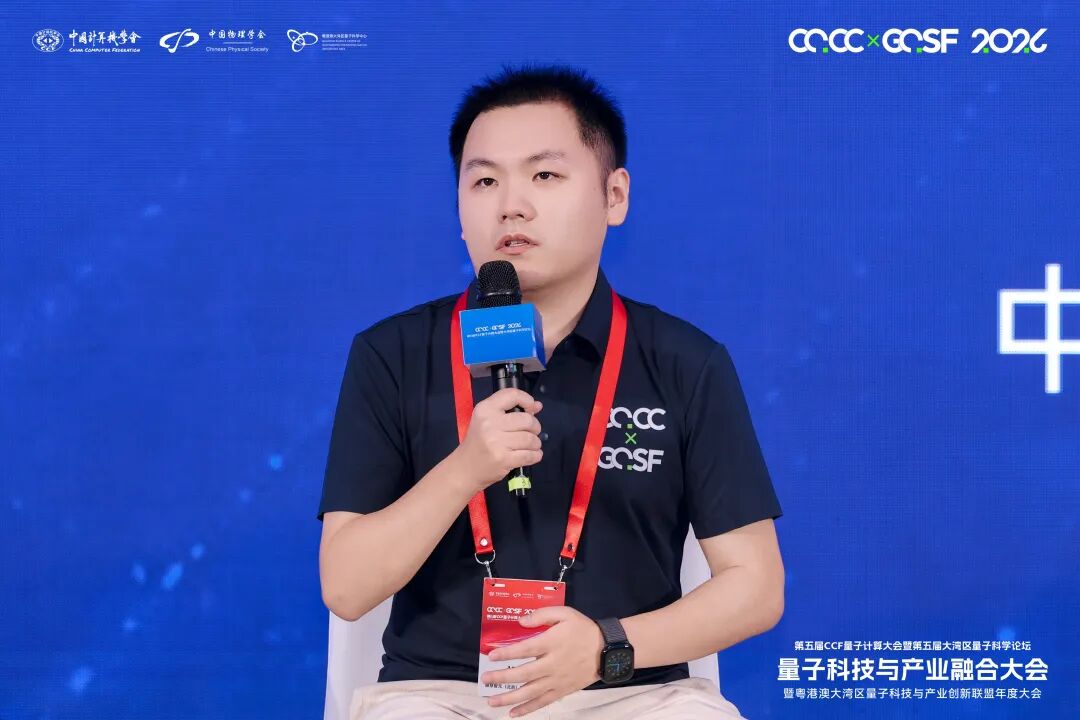
Engineering quantum computing as a complete system
Commercial quantum computing cannot be delivered through a single technical breakthrough. It is a system-engineering challenge spanning chip design, instruction sets, quantum error correction, and control electronics. Zhu noted that these modules are tightly coupled and that many of the hardest problems sit at the boundaries between hardware, software, and different engineering disciplines. A control system, for example, must coordinate efficiently with classical resources such as CPUs and GPUs while also supporting the chosen error-correction architecture.
Traverse Quantum develops hardware and software together to move research results from paper demonstrations toward usable products. Industrial development places particular emphasis on reproducibility, reliable operation, and continuous iteration. Guided by practical product requirements, the team is turning quantum error-correction and full-stack system technologies into engineering capabilities that can be implemented and improved over time.
As investment interest in quantum computing continues to grow, Zhu argued that the industry must respect the underlying technical cycle and maintain a clear boundary between long-term ambition and near-term capability. Capital can support sustained progress only when it moves in step with technology iteration, product development, and application validation. Hardware engineering and quantum error correction are expected to remain decisive areas over the next three to five years.
Designing tomorrow's quantum computer
At the quantum error-correction forum, Tsinghua University associate professor Chen Jianxin presented collaborative work by the university team and Traverse Quantum. The full-stack program spans chip design and system implementation, including high-performance decoders, high-rate codes for grid-like topologies, and the Louvre and Bunny Codes projects. The work treats quantum error correction not as an isolated software problem, but as a system-level discipline connecting chips, control electronics, and implementation architecture.
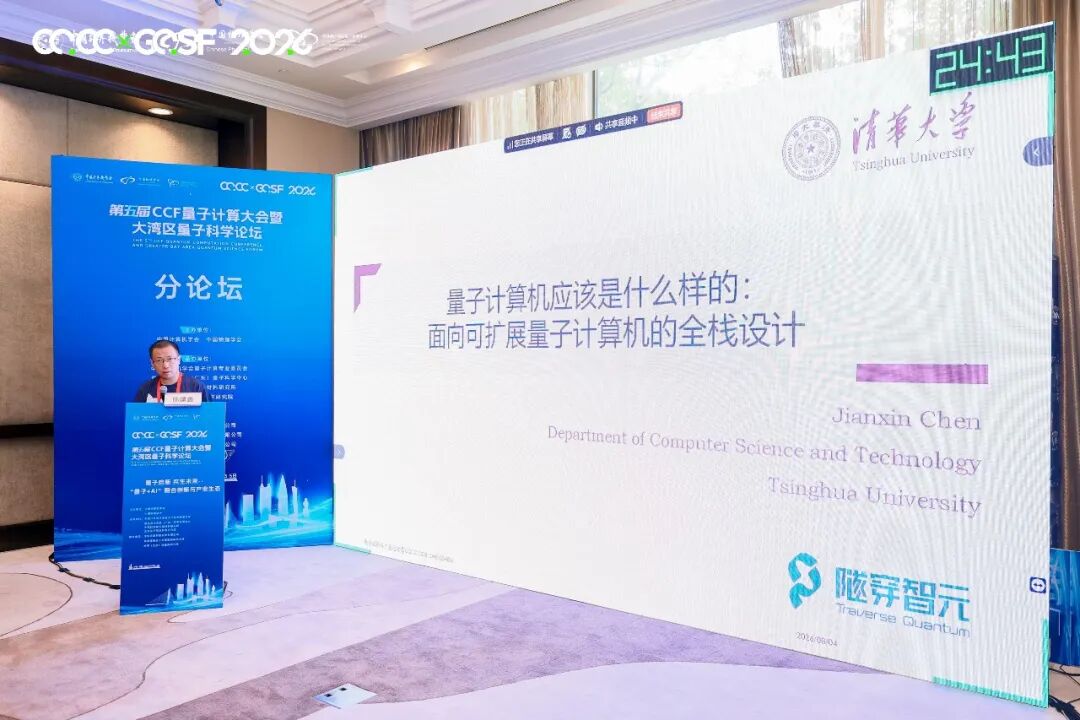
In the forum on integrated innovation and industry, Chen also discussed quantum-computing architecture. System-level optimization can make a superconducting-qubit topology behave close to fully connected in selected scenarios, but the more important question is whether full connectivity is actually required. Applications should define the architecture and requirements should determine the design: once the intended workload is clear, chip and system choices can be made from that goal backward.
With scalable fault-tolerant quantum computing as its long-term objective, Traverse Quantum puts computing capability at the center, hardware as the carrier, systems as the foundation, and design as the engine. The company currently uses superconducting systems as an important validation path and combines ecosystem collaboration with in-house development across error-correction-oriented quantum and classical chip co-design, quantum decoders, instruction sets, and integrated control systems. The engineering decisions made today will help define tomorrow's quantum computer.